
Who is really tracking IT TCO or ROI?
ADP Research Institute found that only 27% consider all factors of IT TCO and only 22% had actually analyzed it within the past year. Historically, research from IT analyst firms like Forrester also aligned with this, showing that upwards of 78% of IT managers do not use TCO measures when calculating specific recurring tech footprints, such as desktop management costs. While almost every tech product claims to reduce TCO, the dirty secret is that everyone knows that few are keeping track.
The gap between acknowledging TCO and actually measuring it comes down to a few major operational hurdles:
- Iceberg Cost Structure: For most IT assets, the initial purchase price accounts for only 20% to 40% of the true lifetime cost. The remaining 60% to 80% is hidden in post-purchase maintenance, support labor, software licensing updates, downtime, and energy consumption.
- Complexity of Modern Stacks: Tracking hidden costs becomes incredibly difficult in hybrid-cloud or multi-SaaS environments. True TCO requires tracking data engineering overhead, compliance risk, and implementation technical debt—metrics that standard accounting departments aren’t natively designed to isolate.
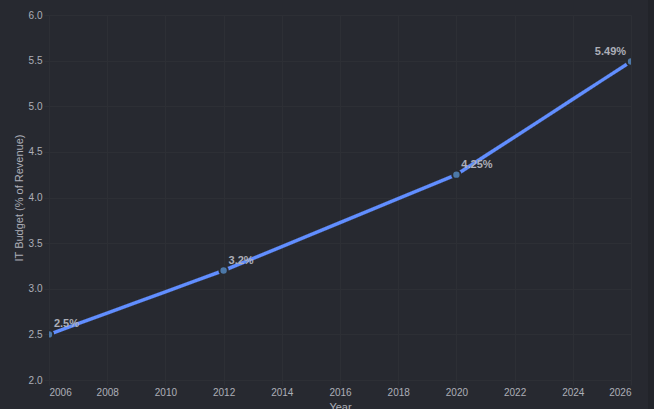
IT cost as a percentage of revenue has doubled in the past 20 years. ROI is the sales pitch, but that simply is not true. In 2006 IT was treated purely as a cost center. Spending was dominated by heavy, upfront Capital Expenditures (CapEx). The widespread shift to AWS, Azure, and enterprise SaaS models transformed IT into an Operating Expense (OpEx) model by 2020. Massive global investments in Artificial Intelligence (AI) infrastructure and exponential cybersecurity threats have fundamentally expanded IT footprints. Infrastructure spending surged by over 62.5% in 2026 alone, cementing IT TCO as an expanding slice of the corporate revenue pie.
The Illusion of Consensus
The technology industry’s heavy financial investments into universities, periodicals, professional organizations, and industry analysis groups create a powerful, self-reinforcing echo chamber. Together, these forces build a powerful illusion of consensus that nudges corporate enterprise decision-makers toward specific IT trends, and supposed cost-saving philosophies. The mechanism functions across four distinct pillars of corporate influence:
- Analysis Groups: Upstream Influence over Evaluation Frameworks
Large-scale IT analyst firms (such as Gartner, Forrester, or IDC) are widely viewed by corporate executives as neutral standard-bearers. While top-tier firms maintain strict conflict-of-interest policies and actively reject direct pay-for-play inclusions, the structural mechanics of their business models favor deep-pocketed tech vendors through indirect influence:
- The Tutor Advantage: Massive tech vendors buy substantial advisory retainers from research firms. While this does not buy a higher position on a ranking matrix, it grants vendors extensive hours with the analysts. Vendors use this feedback loop to learn exactly what evaluation criteria the analysts care about, reshaping their roadmaps and enterprise messaging to seamlessly fit the matrix.
- Creation of Favorable Taxonomy: Dominant technology vendors often work directly with analysts to establish entirely new product definitions or categories. By defining a brand-new software category, a vendor can effectively write a rubric where they are the only logical choice, making specialized or cost-effective legacy alternatives look obsolete.
- Corporate De-risking: For Chief Information Officers (CIOs), adopting a trend backed by a Leader Quadrant entry drastically reduces perceived career risk. This creates an authority bias where decision-makers adopt expensive trends simply because there is safety in numbers.
- Universities: Steering the Academic Research Agenda
When tech enterprises inject funding into university computer science, business, and information technology departments (accounting for billions globally), they pull the focus of academic research toward commercial utility.
- Shaping the Tech Pipeline: Corporate sponsorships dictate which tools, programming languages, and database structures are taught to the next generation of engineers. If a generation of IT graduates is trained entirely on a specific proprietary cloud framework or ecosystem, that ecosystem becomes the unquestioned default standard for future enterprise architecture.
- Selective Problem Scoping: Corporate grants naturally lean toward “applied science” rather than basic foundational science. Funding is funneled toward solving problems that assume a specific framework is already the future (e.g., maximizing efficiency in a hybrid-cloud or hyper-scale AI model), rather than researching whether enterprise organizations should be migrating away from cloud frameworks altogether.
- Trade Periodicals & Media: Amplifying a Singular Narrative
Tech-focused trade publications, magazines, and digital networks rely heavily on advertising dollars, corporate sponsorships, and vendor-provided content to survive.
- The Whitepaper Trap: A significant portion of “research articles” in trade publications are actually native advertising or vendor-funded whitepapers disguised as objective, empirical studies. These papers often focus strictly on specific cost-saving angles (like “reduced CapEx overhead”) while downplaying the long-term TCO traps (such as cloud egress fees or ongoing system maintenance).
- The Seduction of the “Next Big Thing”: In tech journalism, continuous hype generates traffic. Outlining a steady, boring, highly optimized 10-year-old physical infrastructure setup does not generate clicks. Media outlets are structurally incentivized to amplify the latest trend cycles—be it SaaS, serverless architecture, or generative AI infrastructure—contributing to the feeling that “everyone else is moving ahead.
- Professional Organizations: Standardizing the Consensus
Professional bodies, networking circles, and IT certification organizations establish the benchmark standards for what constitutes best practice in the industry.
- Sponsored Frameworks: Many industry certifications and training standards are developed in close collaboration with dominant tech vendors. By embedding proprietary workflows or philosophies into professional certification paths, a specific architectural approach becomes accepted as the industry gold standard.
- Peer Group Homogenization: Professional panels, keynotes, and local tech leadership circles are heavily populated by representatives from multi-billion-dollar tech giants. This visibility heavily anchors the baseline conversation, making localized, frugal, or alternative IT structures seem uncompetitive or outdated.
| Channel | Apparent Consensus | Structural Reality |
| Analysis Groups | “This architectural shift is a proven industry standard.” | Vendors have co-engineered the evaluation frameworks to favor massive tech footprints. |
| Universities | “Independent academic data supports these future tech models.” | Corporate funding selectively pulls research agendas toward commercial monetization goals. |
| Periodicals | “Dozens of case studies show standard cloud savings.” | Ad-driven media relies on vendor content that features heavily optimized, selective success metrics. |
| Professional Organizations | “Best practices dictate this specific software layout.” | Certifications and leadership loops are systematically built around dominant enterprise tooling. |
Ultimately, when an enterprise executive seeks verification on a trending IT initiative, they look to analysts, hire university graduates, read trade journals, and sync with professional peers. Because the technology industry’s investments subtly guide all four channels, the decision-maker finds the exact same narrative everywhere they look, misinterpreting a highly funded corporate marketing ecosystem as an objective, universal truth.
The Truth: Pop Tech Investment has Diminishing Returns
Tech giants want to ensure you will continue to buy more product. Sales is always the bottom line. IT costs are taking a bigger bite out of your bottom line every year. What appears to be the next trend to cost savings is just the latest marketing objective, and most will follow.
The solution is to do your own independent analysis and start thinking outside the box – understand Big Tech’s objective and take everything you read with apprehension.